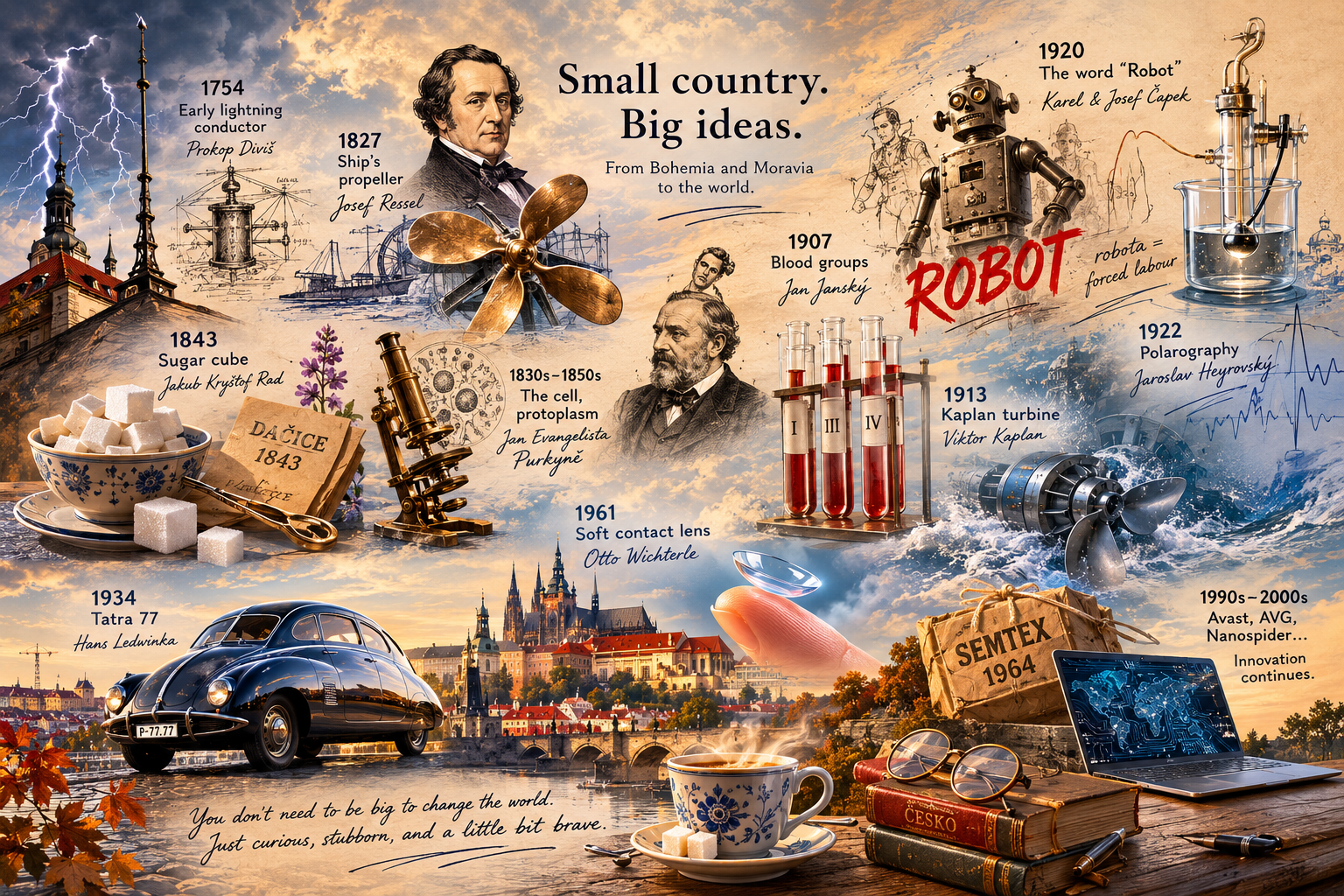
Inventions from the country I grew up in
From the lightning rod to the sugar cube, the word "robot" to soft contact lenses. Let me take you on a personal tour of the everyday things the world uses without knowing they have Czech roots.
There's a special kind of pride that comes with growing up in a small country. It's not the loud, flag-waving kind. It's the quiet satisfaction of knowing that people all over the world use things your country gave them, often without having the slightest idea where they came from.
Growing up in Bohemia or Moravia, you learn pretty quickly that your country isn't big. Our borders have changed more than once during our ancestors' lifetimes, yet somehow this little place in the heart of Europe has kept producing ideas that travelled far beyond them. Looking back, it's hard not to smile at how many everyday things have Czech roots.
1754 – An early lightning conductor
Prokop Diviš, a priest from Přímětice, built what he called a weather machine. His goal was to tame thunderstorms by drawing their energy out of the sky. Unfortunately, when the harvest failed, the locals blamed the machine and tore it down. Diviš developed his idea independently of Benjamin Franklin, but history took a long time to recognise it. There's something wonderfully Czech about that: quietly inventing something remarkable in a village hardly anyone has heard of, only to have your neighbours think you've caused the problem.
1827 – The ship's propeller
Josef Ressel was trained as a forester, yet he came up with the idea that a screw could propel a ship through water. His test in Trieste ended when the engine failed, the authorities stopped further trials, and he never lived to see his idea become standard on ships around the world.
1843 – The sugar cube
One of my favourite stories. In Dačice, Juliana Rad cut her hand while breaking up a traditional sugar loaf. Her husband Jakub, who managed the local sugar refinery, decided there had to be a better way and invented the sugar cube. Every little wrapped cube sitting next to your coffee today is there because one husband wanted to make life just a little easier for his wife.
1830s–1850s – The cell and protoplasm
Jan Evangelista Purkyně wasn't just making scientific discoveries under his microscope in Wrocław and later Prague. He also insisted on teaching in Czech at a time when that was as much a statement as it was a choice. Science and culture went hand in hand for him.
1907 – Blood groups
Jan Janský classified human blood into four groups. While the lettering system is more common internationally today, his original numbering is still familiar to generations of Czech blood donors, and the Jánský Medal remains one of the country's highest recognitions for blood donation.
1913 – The Kaplan turbine
Viktor Kaplan developed a turbine that could efficiently generate electricity from rivers with varying water flow. More than a century later, hydroelectric plants around the world still rely on his design.
1920 – The word "Robot"
Perhaps our most famous contribution to the world's vocabulary. While writing R.U.R., Karel Čapek was looking for a name for artificial workers. His brother Josef suggested roboti, a word derived from robota – the forced labour peasants once owed their landlords.
It's remarkable that a Czech word became part of almost every language on Earth. Even more remarkable is that it arrived carrying a warning. Čapek's robots eventually rebel, reminding us what can happen when people create workers and stop seeing them as living beings. More than a hundred years later, as the world debates artificial intelligence, we're still using a Czech word that originally meant forced labour. That's quite a legacy.
1922 – Polarography
Jaroslav Heyrovský developed polarography, an analytical method that earned him the Nobel Prize in Chemistry in 1959. It remains the only Nobel Prize awarded to Czechoslovakia in the natural sciences.
1934 – The Tatra 77
Designed by Hans Ledwinka in Kopřivnice, the Tatra 77 became the world's first mass-produced aerodynamic car. Even today it looks like something that drove straight out of the future.
1961 – The soft contact lens
Otto Wichterle's story might be the most inspiring of them all. Prevented from working at his university, he continued his research at home. During Christmas, using his children's Merkur construction set and a gramophone motor, he created the first successful soft contact lenses in his own house. The state later sold the patents abroad for almost nothing, and Wichterle saw little reward at the time. Yet millions of people start every day seeing the world clearly thanks to a scientist who refused to give up just because someone closed the laboratory door.
1964 – Semtex
Stanislav Brebera developed Semtex in Semtín near Pardubice. Not every invention we shared with the world was quite as friendly as sugar cubes or contact lenses.
1990s–2000s – Avast, AVG and Nanospider
Innovation certainly didn't stop in the twentieth century. Czech software like Avast and AVG has protected computers across the globe, while researchers in Liberec helped pioneer nanofibre technology. It's a nice reminder that the country's inventive spirit is still very much alive.
When I look through this list, I'm reminded that you don't need to be a superpower to leave a mark on the world. Sometimes all it takes is curiosity, stubborn determination, and a willingness to keep going even when nobody believes in your idea. That's something Czechs have always been surprisingly good at.